Monday, October 16, 2006

I'm a 40pc Political Junkie

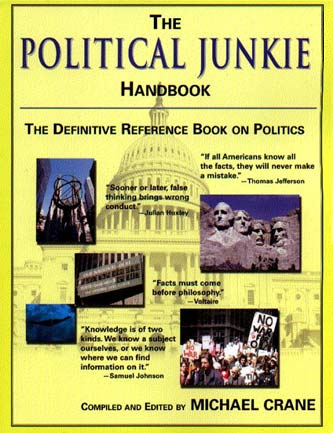
I love all these Twenty Questions-type surveys that go round the blogosphere, so here, via Brod Blog, Mars Hill and Iain Dale is the latest, the Political Junkie Test.

The things that are true about me are in bold:

You're a political junkie if.......

1. The first thing you do in the morning is check the BBC’s politics website, followed by the broadsheets.
2. You can name 10 Lib Dem MPs.
3. The Today programme is as much a morning routine as brushing your teeth and taking a piss.
4. You know the URLs for the Top Three political blogs from memory.
5. In your briefcase is a copy of Private Eye, an iPod, and Alan Clarke’s biography.
6. You read Boris every week, even if its only to disagree.
7. You record Question Time via Series Link on your SKY + box.
8. You know the Huffington Post is not a newspaper from a town called Huffington.
9. You know who Nicholas Sarkozy is
10. Your family never brings up politics in your presence.
11. You have a complex opinion of Tony Blair.
12. You actually know where the politics section is at your local Waterstones.
13. You always vote.
14. Your water cooler conversations usually revolve around a recent Westminster scandal.
15. You have given money to a political party, via either membership or a donation.
16. Your dream is to appear on Question Time yourself.
17. You read political blogs during your lunch hour.
18. You see more of Iain Dale or Recess Monkey than your children, sadly
19. You can name the last four foreign secretaries.
20. You have a ‘handle’ at Labourhome.


I make that a score of 8 out of 20, or 40pc. A bit of a politics junkie, then, but not exactly mainlining on it.

unique visitors counter

Friday, October 13, 2006

Now even Blair's generals defy him

Ever since Tony Blair announced he would not fight a fourth election, we have witnessed a slow ebbing away of his authority. But today, that process took on a new dimension with the comments by General Sir Richard Dannatt over the War in Iraq.

Contradicting everything Mr Blair has been telling us since the start of the conflict, Army chief Sir Richard said the continued presence of our troops in Iraq was endangering British security, that they needed to be brought home "sometime soon."

Ordinarily, a Chief of General Staff who made a comment so undermining of government policy would be summarily sacked. But Mr Blair cannot afford to make Sir Richard a martyr to the anti-war cause any more than he could have done in relation to Gordon Brown in 2003 (see previous post.)

Parallels are now being increasingly drawn with the Suez crisis fifty years ago. Few questioned then that withdarwal was the right thing to do, but it still cost Anthony Eden his job.

16 Oct Update: More in this vein on my Week in Politics Podcast which is now online. The full text version is available HERE.

* Apologies to my regular visitors for the lower-than-normal volume of posts this week. I do however have a busy "day job" which is completely unrelated to my political writing, and until the day when this blog can pay me a living (!) it must always come first.

unique visitors counter

Wednesday, October 11, 2006

Blunkett is re-writing history

In the latest instalment of his diaries currently being serialised in the Guardian, David Blunkett claims that Gordon Brown only backed the Iraq War at the last minute after concluding that Tony Blair would sack him if he didn't. As well as making the paper's front-page splash this morning, this story was also being talked-up by a wide-eyed Nick Robinson on last night's 10 O'Clock News.

I am genuinely surprised at both the Guardian and the Beeb for giving this such credence. If they had cast their minds back to 2003 for a few seconds, they would surely have realised that any notion of the Prime Minister being able to sack the Chancellor at that juncture is palpably absurd.

The Iraq War was, and is, a bitterly divisive issue for the Labour Party. Tony Blair was extremely fortunate that only two Cabinet ministers, Robin Cook and Clare Short, resigned over it, and furthermore that they did so in such a way that the parliamentary opposition to the conflict was fragmented rather than brought together.

The idea that, in this highly unstable political situation in which his premiership hung by a knife-edge, Tony Blair could have sacked Gordon Brown without triggering a successful coup against his leadership is, as Charlie Whelan would say, bollocks.

Then again, it does throw up what would surely be an interesting chapter in a book of political counterfactuals, were Iain Dale and Duncan Brack ever tempted to repeat that exercise.

Had Blair been daft enough to make Brown a martyr to the anti-war cause in, say, March 2003 after the first phase of the conflict ended, Brown would undoubtedly have become Prime Minister by the summer of that year after the unravelling of the Government's case for the war and the suicide of Dr David Kelly.

Mr Brown, untainted by the "trust" issue that attached itself to Mr Blair post-Kelly, would then have led Labour to a third successive 100-plus landslide, reducing the Tories to a parliamentary rump and producing in them such a collective nervous breakdown that their prospects of ever regaining power became negligible.

In other words, if we really were living in David Blunkett's parallel universe, the cause of the left in British politics might today be looking a damned site healthier.

unique visitors counter